Here is something most men do not know: testicular cancer is one of the most treatable cancers in the world — especially when caught early.
Yet it is also one of the most under-discussed. Men delay appointments. They dismiss symptoms. They search online for weeks before speaking to a doctor.
If you have noticed a lump, swelling, heaviness, or unexplained discomfort in the scrotal area, this guide is for you. It covers everything you need to know about testicular cancer: what it is, what causes it, how to recognise the symptoms, and exactly when to seek specialist care in Greater Noida.
What Is Testicular Cancer?
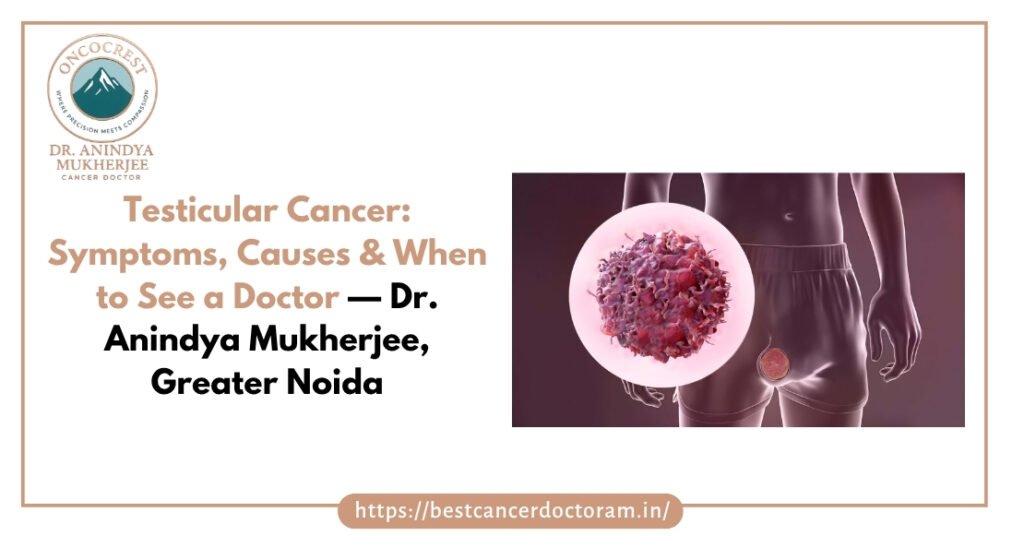
What is testicular cancer? It is a cancer that develops in one or both testicles — the two oval-shaped glands located inside the scrotum that produce male sex hormones and sperm.
Testicular cancer begins when cells inside the testicle grow abnormally and multiply without control. Over time, these cells form a tumour — and if left untreated, that tumour can spread to lymph nodes, lungs, or other organs.
The good news: testicular cancer responds exceptionally well to treatment. Survival rates are among the highest of any cancer type — over 95% when detected at an early stage. This makes early recognition of testicular cancer symptoms the single most important factor in a patient’s outcome.
Testicular cancer is most commonly diagnosed in men between the ages of 15 and 45, making it the most common cancer in young Indian men in this age group. It is not a disease of old age. It is a disease that can affect a man in his prime years — and that is exactly why awareness matters.
Types of Testicular Cancer
Understanding what testicular cancer looks like at the cellular level helps explain why treatment approaches vary between patients.
Seminomas develop from germ cells in the testicle and grow relatively slowly. They are highly sensitive to radiation therapy and respond very well to treatment. Classic seminoma is the most common form.
Non-Seminomas are more aggressive and tend to grow faster, but are still very treatable.
They include subtypes such as embryonal carcinoma, teratoma, choriocarcinoma, and yolk sac tumours. If a tumour contains both seminoma and non-seminoma cells, it is treated as a non-seminoma.
Scrotum cancer — a broader term sometimes used by patients — typically refers to cancers involving the scrotal skin or underlying testicular tissue. While distinct from internal testicular cancer, it also requires urgent specialist evaluation.
Testicular Cancer Causes: Why Does It Happen?
Testicular cancer causes are not fully understood — meaning there is no single trigger that definitively causes every case. However, research has identified several clear risk factors that significantly increase a man’s likelihood of developing testicular cancer.
Undescended Testicle (Cryptorchidism)
The most well-established of all reasons for testicular cancer is a condition called cryptorchidism, where one or both testicles fail to descend from the abdomen into the scrotum before birth. Even when surgically corrected, the risk of testicular cancer in that testicle remains elevated.
Family History
Men whose father or brother has had testicular cancer face a significantly higher risk than the general population. A family history of the disease is one of the strongest predictors of individual risk.
Previous Testicular Cancer
A man who has had testicular cancer in one testicle has a higher-than-average risk of developing it in the other testicle in the future. Regular follow-up monitoring is essential after treatment.
Age and Hormonal Factors
How does testicular cancer occur in young men specifically? Research suggests that hormonal exposure during foetal development — particularly elevated oestrogen levels — may play a role in abnormal germ cell development, which is one of the primary testicular cancer causes.
Birth Defects and Congenital Abnormalities
Structural abnormalities of the penis, testicles, or kidneys present from birth are associated with elevated testicular cancer risk.
Other Contributing Factors
- HIV infection has been linked to increased risk, particularly for seminomas
- Exposure to certain pesticides and industrial chemicals is under investigation as a contributing reason for testicular cancer.
- Being of a certain ethnicity, testicular cancer is more common in men of European descent globally, but this does not mean Indian men are immune; cases in NCR and Greater Noida are diagnosed regularly.
Talk to a Cancer Specialist today and get clarity on your symptoms.
Testicular Cancer Symptoms: What to Look For
Most men discover testicular cancer symptoms themselves — not through a doctor’s examination. This makes self-awareness the first line of defence.
Here are the signs of testicular cancer to watch for:
A lump or swelling on a testicle — this is the most common of all testicular cancer symptoms. The lump is usually painless. Many men dismiss it because it does not hurt — but painlessness does not mean it is harmless. Any new lump in the testicle must be evaluated.
A heavy feeling in the scrotum — one of the more subtle scrotum cancer symptoms, this sensation of fullness or weight is often described as feeling like “something has changed” without being able to name exactly what.
A dull ache in the lower abdomen, groin, or back — testicular tumor symptoms can radiate beyond the scrotum. Pain or aching in the lower abdomen or back — especially without an obvious cause — may indicate that a testicular tumor has begun to affect nearby lymph nodes.
A change in the size or texture of a testicle — one testicle becoming noticeably firmer, larger, or differently shaped than before is a classic early sign of testicular cancer.
Fluid collecting in the scrotum (hydrocele) — sudden fluid accumulation around the testicle can occasionally be associated with an underlying scrotum tumor and should be investigated rather than assumed to be benign.
Breast tenderness or growth (gynaecomastia) — some testicular cancer types produce hormones that cause breast tissue changes. This symptom is often overlooked as unrelated.
Fatigue and unexplained weight loss — in more advanced testicular cancer, systemic symptoms appear as the cancer spreads beyond the testicle.
How to Find Out If You Have Testicular Cancer
How to find out if you have testicular cancer starts with a simple monthly self-examination:
- Perform the check after a warm shower when the scrotal skin is relaxed
- Use both hands — gently roll each testicle between your thumb and fingers
- Feel for any hard lumps, changes in size, firmness, or texture
- Compare one testicle to the other — some size difference is normal, but a new asymmetry is not
If you find anything — even if it does not hurt — do not wait. Book an appointment with a specialist. Early-stage testicular cancer is cured in the vast majority of cases. Late-stage disease is far more complex to treat.
Scrotum Cancer vs. Testicular Cancer: Understanding the Difference
Patients often search for ball cancer, scrotum cancer, or scrotum tumor — and it is worth clarifying the distinction.
Scrotum cancer technically refers to cancer of the scrotal skin — historically associated with occupational chemical exposure, though rare today. Testicular cancer, by contrast, originates inside the testicle itself.
Testicular tumor symptoms and scrotum cancer symptoms can overlap — both may present with a visible lump or swelling, which is why clinical evaluation is essential. A scrotal ultrasound can distinguish between the two in most cases.
Both require urgent specialist attention. Neither should be self-monitored at home beyond initial detection.
Speak directly with an experienced oncologist and discuss the best treatment plan for you.
Diagnosis: What Happens When You See a Doctor
When a patient in Greater Noida visits Dr. Anindya Mukherjee’s clinic with suspected testicular cancer symptoms, the diagnostic process is structured and efficient:
Clinical examination — A thorough physical examination of both testicles, lymph nodes, and abdomen is the starting point.
Scrotal ultrasound — The primary imaging tool for testicular cancer. It produces a detailed picture of the internal structure of the testicle and can identify most tumours within minutes. It is painless, radiation-free, and highly accurate.
Blood tumour markers — Blood tests measure three key markers: AFP (alpha-fetoprotein), BHCG (beta-human chorionic gonadotropin), and LDH (lactate dehydrogenase). Elevated levels of these markers strongly suggest a testicular tumor, even before it is visible on imaging. These markers are also used after treatment to monitor for recurrence.
Biopsy and staging scans — If a tumour is confirmed, CT scans of the chest and abdomen determine whether testicular cancer has spread to lymph nodes or other organs. This determines the stage of disease and guides treatment decisions.
Can Testicular Cancer Be Cured?
Can testicular cancer be cured? Yes — and this is one of oncology’s most encouraging answers.
Testicular cancer has a five-year survival rate exceeding 95% when diagnosed at Stage 1 (confined to the testicle). Even Stage 3 disease — where cancer has spread to distant lymph nodes or organs — is curable in the majority of patients with appropriate treatment.
Can testicular cancer kill you? It can — but only when it goes undetected and untreated for a prolonged period, allowing it to spread significantly. The overwhelming majority of men who receive timely, specialist treatment go on to live full, healthy lives.
How to Treat Testicular Cancer
How to cure testicle cancer depends on the type, stage, and the patient’s age and health. Dr. Anindya Mukherjee develops personalised treatment plans for every patient, typically combining:
Surgery (Orchiectomy) — Removal of the affected testicle through a small incision in the groin. This is almost always the first step in treatment, regardless of stage. A man with one healthy testicle can still produce testosterone, maintain sexual function, and father children. A prosthetic testicle can be placed for cosmetic symmetry if desired.
Radiation Therapy — Used primarily for seminomas after surgery. High-energy beams target lymph nodes in the abdomen to destroy any remaining cancer cells. Dr. Mukherjee offers targeted radiation therapy at ShardaCare HealthCity, Greater Noida.
Chemotherapy — Used for non-seminomas, advanced-stage seminomas, or when cancer has spread. Combination drug regimens (typically BEP — bleomycin, etoposide, cisplatin) are highly effective in testicular cancer and can achieve a cure even in metastatic disease.
Fertility Preservation — Before beginning chemotherapy or radiation, Dr. Mukherjee’s team discusses sperm banking with all patients who may wish to father children in the future. This conversation happens before treatment begins — not after.
Coping with a Testicular Cancer Diagnosis
A testicular cancer diagnosis affects more than the body. It raises questions about identity, masculinity, fertility, sexual function, and the future.
These concerns are valid. They deserve direct, compassionate answers — not vague reassurance.
At Dr. Anindya Mukherjee’s cancer clinic in Greater Noida, every patient receives not just a treatment plan but a full support conversation. This includes honest guidance on:
- Sexual function after orchiectomy — most men retain full function with one testicle
- Fertility options — sperm banking before treatment preserves the option to have children later
- Body image — prosthetic testicle placement is available for those who want it
- Emotional wellbeing — connecting with counselling support or patient communities during treatment
These conversations happen in a private, respectful, and entirely confidential consultation environment. No question is too sensitive to ask.
About Dr. Anindya Mukherjee — Testicular Cancer Specialist, Greater Noida
When a lump is found, the first instinct is fear. The second should be finding the right specialist — someone who combines clinical expertise with clear communication and genuine compassion.
Dr. Anindya Mukherjee is a Senior Medical Oncologist at ShardaCare HealthCity, Knowledge Park III, Greater Noida, and one of the most experienced cancer specialists in Greater Noida for both haematological and solid tumour oncology, including testicular cancer.
Dr. Mukherjee delivers internationally benchmarked cancer care to residents of Greater Noida, Alpha 1, Beta 2, Knowledge Park, Pari Chowk, Jewar, Dadri, and the broader NCR region — without the need to travel to central Delhi for specialist-level consultation.
His approach is simple: accurate diagnosis, evidence-based treatment, and honest, compassionate communication at every step of the patient journey.
📍 Room 205, Basement 2, ShardaCare HealthCity, Knowledge Park III, Greater Noida – 201310 📞 +91 9958080211 🕐 OPD: Monday – Saturday | 10:00 AM – 5:00 PM
📞 Found a Lump? Do Not Wait — Book a Consultation Today
Testicular cancer is highly treatable. But treatment outcomes depend directly on how early you act.
If you have noticed any testicular cancer symptoms — a lump, swelling, heaviness, or change in the scrotum — please do not wait to see if it goes away on its own. Book a confidential consultation with Dr. Anindya Mukherjee today.
Dr. Mukherjee’s clinic offers:
- Confidential, respectful consultations for all men’s oncology concerns
- Scrotal ultrasound referral and tumour marker testing within days
- Personalised treatment planning from a specialist with 15+ years of oncology experience
- Video consultations for patients across Greater Noida and NCR who prefer a remote first appointment
👉 Call or WhatsApp: +91 9958080211👉 Book a Video Consultation: bestcancerdoctoram. in
Early action saves lives. One call can make all the difference.
FAQs: Testicular Cancer
Q1. What is testicular cancer?
Testicular cancer is a cancer that begins in the testicles — the glands responsible for producing sperm and male hormones. It occurs when cells inside the testicle grow and divide abnormally, forming a tumour. It is the most common cancer in men aged 15–45 and is highly treatable when caught early.
Q2. Can testicular cancer kill you?
Advanced, untreated testicular cancer can be fatal. However, with timely specialist treatment, over 95% of men with early-stage disease are cured. Even advanced-stage testicular cancer has cure rates well above most other cancers. Early detection and prompt treatment are the key factors.
Q3. Can testicular cancer be cured?
Yes. Testicular cancer is one of the most curable cancers in oncology. Stage 1 disease has a cure rate exceeding 95%. Even Stage 3 metastatic disease is cured in the majority of patients with modern chemotherapy protocols. The word “curable” genuinely applies here — but only with proper treatment.
Q4. How does testicular cancer occur?
How testicular cancer occurs is not fully understood, but known triggers include an undescended testicle at birth, family history of the disease, previous testicular cancer, and certain congenital abnormalities. Abnormal germ cell development — possibly linked to hormonal factors during foetal development — is believed to be the primary underlying mechanism.
Q5. How to find out if you have testicular cancer?
How to find out if you have testicular cancer begins with a monthly self-examination — feeling each testicle for lumps, changes in size or texture, or unexplained heaviness. If anything feels different from before, see a specialist immediately. A scrotal ultrasound and blood tumour marker test are the standard first diagnostic steps.
Q6. How to cure testicle cancer?
How to cure testicle cancer depends on the type and stage. Most patients begin with surgery to remove the affected testicle (orchiectomy), followed by radiation therapy, chemotherapy, or close surveillance depending on staging. Modern protocols achieve a cure in the vast majority of patients — even those with spread beyond the testicle.
Q7. What are the most common testicular cancer symptoms?
The most common testicular cancer symptoms are a painless lump or swelling on a testicle, a heavy sensation in the scrotum, a dull ache in the lower abdomen or groin, and a change in the size or firmness of a testicle. Most men find these signs of testicular cancer themselves during self-examination or bathing.
Q8. Is testicular cancer painful?
Early testicular cancer is usually painless, which is why many men delay seeking help. The absence of pain does not mean the lump is harmless. Any new, persistent lump in the testicle — painful or not — should be evaluated by an oncologist without delay.